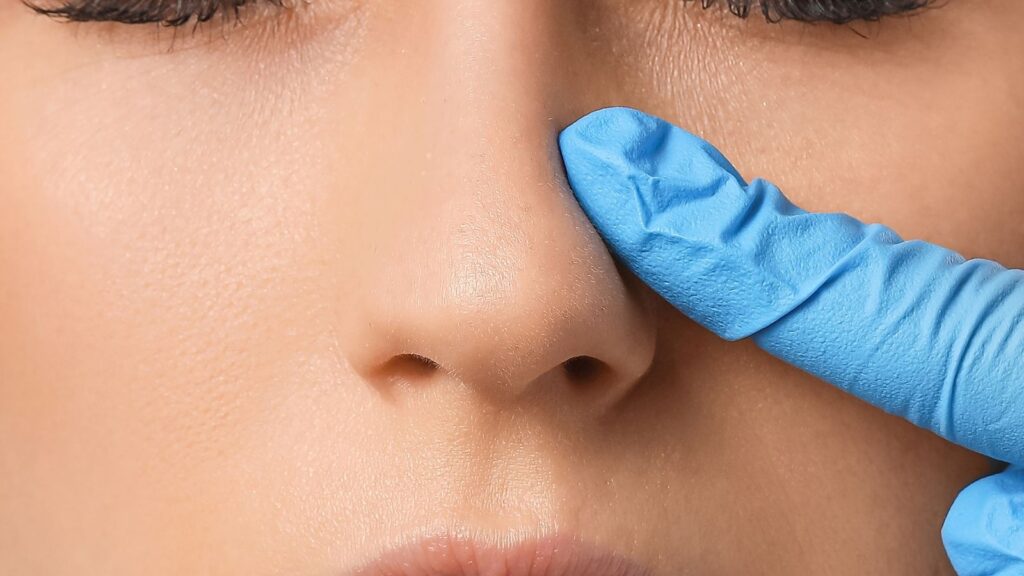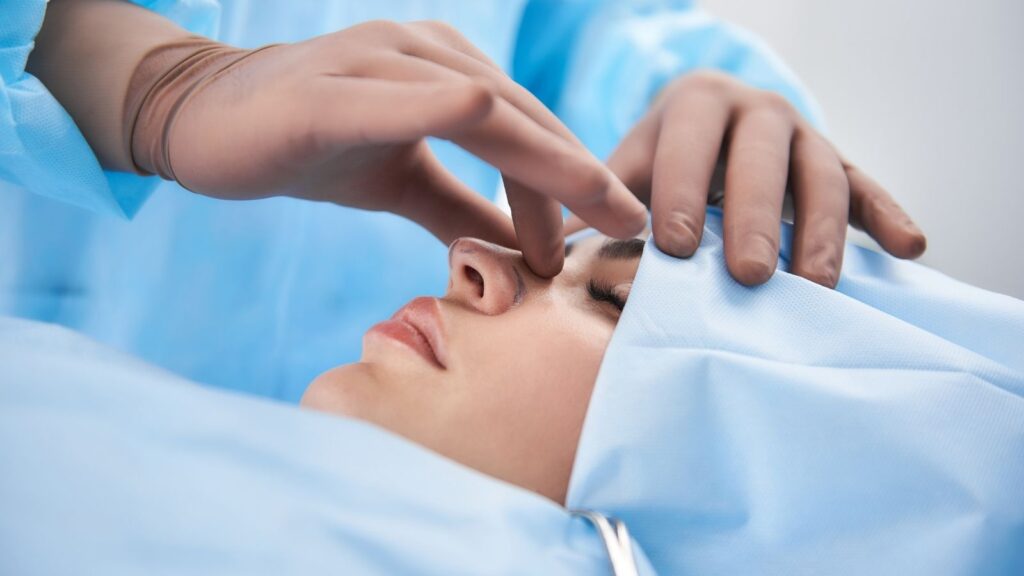
The Greek nose is a classic nose type characterized by a straight, non-projecting nasal bridge. Frequently seen in Ancient Greek sculptures, this form is associated with symmetry and elegance in aesthetics. There is no distinct slope between the nasal root and the tip, offering a linear profile.
Greek nose aesthetics are generally achieved by preserving the natural structure while eliminating irregularities on the nasal dorsum. By filing the nasal bone, a straight line is obtained. This procedure is especially applied to individuals with a hooked (humped) nasal structure.
The question of who looks aesthetically pleasing with a Greek nose is related to the overall proportions of facial features. In people with forehead–nose–chin harmony and an oval or symmetrical facial structure, the Greek nose type appears quite balanced and natural. Personal facial analyses are important.
There are differences between the Greek nose and the Roman nose type. While the Roman nose is generally defined by its arched structure, the Greek nose offers a completely straight profile. In aesthetic preferences, these differences should be considered and individualized planning should be carried out.
| Things You Should Know | Information |
| Definition | “Greek nose” (Grecian nose) is the classic and symmetrical nose type in which the nasal dorsum is straight, the nasal bone has no prominence, and the nasal tip continues without forming a distinct angle with the forehead. |
| Anatomical Features | There is a straight line between the nasal root and the nasal tip. The nasal bridge is non-projecting and straight. The nasal tip is usually slightly upturned, and the nostrils are not very visible. |
| Aesthetic Features | This nose shape, frequently seen in Ancient Greek sculptures, has been accepted as the ideal nose type in Western aesthetic understanding. |
| Genetic Factors | It is generally seen in individuals of Mediterranean origin. It may show familial transmission. |
| Prevalence | It is not very common naturally. It is one of the nasal forms frequently targeted in aesthetic surgery. |
| Aesthetic Requests | In rhinoplasty, patients may often request a “Greek-style” nasal profile. |
| Treatment Methods | With surgical rhinoplasty, the existing nose shape can be corrected to achieve a Greek nose-like appearance. |
| Rhinoplasty Techniques | The hump on the nasal dorsum can be removed, the nasal bridge is straightened, the nasal tip is reshaped, and a natural transition is ensured. |
| Advantages | When viewed from the profile, it offers a symmetrical, balanced, and elegant appearance. It suits most face types. |
| Points to Consider | Not every face type is suitable for the Greek nose form; the nose shape should be proportional to the overall facial structure. |
What Is Greek Nose (Straight Profile) Aesthetics and Why Is It Different?
In aesthetic surgery, the term “Greek Nose” is used to describe a specific anatomical condition. Under normal circumstances, in an ideal facial profile, a slight indentation—a transition zone—is expected at the point where the forehead ends and the nose begins. This transition allows the eyes to stand out and draws an aesthetic boundary between the nose and the forehead. However, in individuals with Greek nose morphology, this transition zone—namely the nasal root—is either very full or completely flat.
We can describe the effect this has on the face as follows: There is no sense of depth in the profile. The nose descends as if it is a continuation of the forehead. This makes the nose appear much longer, larger, and more dominant than it actually is. Many patients come to us complaining, “My nose is very big,” but upon closer evaluation we see that the issue is not the size of the nose so much as the fact that its starting point is too high and full.
The visual effects created by this aesthetic problem are:
- Harsh facial expression
- Flat, depthless profile
- Eyes that remain in the background
- Masculine appearance
- Perception of a long nose
Therefore, this operation is not merely a reduction procedure. It is a comprehensive reshaping process that changes the face’s center of balance, reveals the gaze, and restores the lost elegant curvature to the profile.
Why Is the Radix (Nasal Root) Region So Important in Facial Aesthetics?
Think of a building’s architecture: just as the junction between the foundation and the wall is critical, the radix region is just as critical in facial aesthetics. The radix is the starting point of the entire nasofacial profile. How high the nasal dorsum appears, how far forward the nasal tip projects, and how elegant the profile looks all depend entirely on this starting point.
Anatomically, this is one of the most solid and deep structures of the face, where the frontal bone and the nasal bones meet. However, its aesthetic importance is even greater than its anatomical strength. If the radix region is not positioned correctly, no matter how perfect the rest of the rhinoplasty is, the result will look artificial or unsatisfying.
Having the radix at an ideal depth is possible by properly setting the forehead–nose angle, which we call the “Nasofrontal Angle.” When this angle is too wide (as in the Greek nose), the face looks like a completely flat plane. Our aim is to define the “beginning” of the nose by creating a millimetric curvature in this area. This seemingly small touch is actually a magical key that changes the harmony of the entire face. When the radix is lowered and deepened, the nose automatically begins to look shorter, more upturned, and more refined.
Is the Greek Nose Structure Common in Turkish Society?
Our genetic heritage is the most important factor shaping our facial features. Although the measurements accepted as “ideal” in aesthetic surgery literature are often determined according to European or North American standards, we physicians know very well that each geography has its own unique anatomy. Scientific studies conducted on the Turkish population and our clinical observations show that the Greek nose or high radix structure is quite common in our region.
Speaking in the light of scientific data, an ideal nasofrontal angle (forehead–nose angle) is generally accepted to be between 127 and 141 degrees. This range is the one that creates the most pleasing and natural curvature to the eye. However, detailed measurements on Turkish patients have revealed that our average is approximately 153 degrees. This is a very significant difference. In other words, in our society the nasal root starts much higher and descends much flatter than the global average.
In fact, studies have found that in almost all of the Turkish patients examined, the radix region was much higher than ideal limits. This tells us: a surgeon performing rhinoplasty in Turkey must be highly experienced in radically lowering (reducing) the radix region. Because in our patients, it is not enough to simply remove the hump; lowering the high platform where the nose begins to an ideal level is an anatomical necessity.
These structural characteristics include:
- High nasal root
- Thick forehead skin
- Strong bony structure
- Prominent nasal dorsum
What Is the Tissue Memory Problem During the Postoperative Healing Process?
One of the greatest challenges that distinguishes Greek nose aesthetics from standard rhinoplasty is the tendency for “tissue memory,” medically referred to as recurrence. This is one of the issues our patients ask about and worry about most: “Doctor, we hollowed out my nasal root, but what if that area fills up again?” This is not an unfounded concern, because the radix region is among the areas where the body is most resistant to surgery.
Our bodies have an excellent defense mechanism; they do not like empty spaces. When we create a hollow or indentation by thinning the bone during surgery, the body immediately acts to fill that space during healing. It sends a healing tissue we call “fibrosis” to the area. This tissue is a natural part of wound healing, but from an aesthetic standpoint it can be our enemy.
If the tissue is subjected to excessive trauma during surgery, if there is a lot of bleeding, or if the soft tissue is not thinned adequately, the body repairs that area excessively. As a result, the beautiful curve that looks great on the operating table gradually fills with fibrotic tissue over months, and the profile starts to flatten again. We call this “tissue memory”; the tissue tries to return to its former flat state.
For this reason, the success of this surgery depends not only on how much bone you remove at that moment, but also on how you manage the body’s response during the healing process. A successful surgeon performs the operation by planning not only for today but also for one year later.
Factors that increase the risk of recurrence are:
- Thick skin structure
- Excessive surgical trauma
- Insufficient bone reduction
- Leaving muscle tissue behind
- Postoperative edema
How Has Piezo (Ultrasonic) Technology Revolutionized Radix Aesthetics?
In the past, when technology was not as advanced, lowering a high nasal root was a fairly traumatic process for both surgeons and patients. Mechanical rasps, chisels, and hammers used to thin the bone could damage surrounding tissues even with great care. This coarse trauma increased the risk of “excessive healing tissue,” namely fibrosis, mentioned above. In addition, since the radix region is very close to the brain and the eyes, using a hammer and chisel in this area always carried certain risks.
This is exactly where Piezo, or ultrasonic bone-shaping technology, came into play and changed the rules of the game. The Piezo device does not use mechanical impact force to break bone. Instead, it sculpts the bone like an artist with micro-vibrations created by high-frequency sound waves.
The greatest advantage this technology provides in radix aesthetics is “selectivity.” Piezo tips recognize only hard tissue (bone). The moment they touch soft tissue, a vessel, a nerve, or muscle, they stop and do not cause damage. This allows us to work with millimetric precision in the nasal root, which is a very risky and deep region. While thinning the bone as much as we want, we do not harm any vital structures around it.
Less bleeding, less bruising, and less tissue damage. Less tissue damage means the body does not declare an “emergency” and does not try to fill that region with fibrotic tissue. In other words, Piezo not only provides a comfortable recovery, but also contributes biologically to the permanence of the result.
The advantages of Piezo surgery are:
- Millimetric bone cutting
- Soft tissue preservation
- Reduced risk of bruising
- Faster recovery process
- Permanent results
Why Are the Procerus Muscle and Soft Tissue Intervention Essential?
This section contains perhaps the most critical and least-known secret of Greek nose surgery. Most of the time, patients (and sometimes inexperienced surgeons) think the problem is only in the bone. Unfortunately, the logic of “If we file the bone, a curve will form” does not work in these cases. Because over the bone at the nasal root, there is a fairly thick and strong muscle group called the “Procerus” and a thick skin layer:
You can imagine it like this: Think of a very thick, fluffy carpet laid on the floor. No matter how much you carve out the ground underneath, as long as that thick carpet remains, the hollow will not be apparent from the outside. The Procerus muscle is that thick carpet. Ultrasonographic measurements have shown that this muscle can be about 3 millimeters thick in the radix region, and even thicker in some patients.
Even if you carve the underlying bone perfectly, this 3-millimeter layer of muscle and skin covers and masks that space. Therefore, to obtain a true and lasting curve, bone thinning must be combined with soft tissue surgery. In these operations, we not only remove bone, but also surgically thin the Procerus muscle or remove part of it (resection).
This technique is actually an advanced method borrowed from facelift or brow-lift surgeries. Thinning the muscle both reduces the “load” over the bone and weakens the mechanism that causes the area to become full again. Thus, the resulting curve remains clear and distinct even years later.
The stages of soft tissue management are:
- Subcutaneous fat removal
- Procerus muscle release
- Muscle tissue excision
- Skin thinning procedures
Why Should Open Technique Rhinoplasty Be Preferred in This Surgery?
Discussions about open versus closed rhinoplasty are always popular. Both techniques have their own advantages. However, when it comes to radix reduction and Greek nose correction, the open technique is not just a preference for the surgeon; it is almost a necessity.
The open technique involves lifting the nasal skin through a millimetric incision at the nasal tip. This makes the nasal dorsum, the cartilages, and most importantly the deep radix region fully visible to the naked eye. The procedures we perform in Greek nose surgery (deep bone carving with Piezo and cutting/removing the Procerus muscle) are not procedures that can be done blindly.
In order to separate the muscle from the bone in that region, decide how much muscle to remove, and thin the bone symmetrically, “visual control” is essential. In the closed technique, reaching this region and safely performing muscle resection is extremely difficult and risky. The open technique allows the surgeon to work with full control in this complex anatomy without leaving room for error. Touching while seeing prevents surprising results and maximizes safety.
How Does the Preoperative Planning and Simulation Process Proceed?
A successful aesthetic operation begins not in the operating room, but in the consultation room. Especially in specific and challenging cases like the Greek nose, the patient’s expectations must align with surgical realities. Each patient’s facial anatomy, forehead structure, and chin position are different.
In the detailed analyses we perform before surgery, we do not focus only on the nose. Factors such as the slope of the forehead, how far back or forward the chin is, and the prominence of the cheekbones determine how much the nasal root should be lowered. For example, in a patient with a very retruded forehead, hollowing the radix too much can make the nose look detached from the forehead. Conversely, in a patient with a very steep and prominent forehead, insufficient reduction can result in the profile not improving.
At this stage, we benefit from digital simulation technologies. With millimetric adjustments on the patient’s photographs, we visualize the answer to the question, “How would your profile look if we lower the nasal root by 3 millimeters?” These simulations help the patient adapt to their new face, while also serving as a map that shows us the target we need to reach during surgery. In addition, analyzing skin thickness enables us to plan how much we need to intervene in the soft tissue.
The parameters considered during analysis are:
- Forehead slope and structure
- Chin tip position
- Skin thickness and quality
- Intercanthal distance
- Current bone height
What Should Be Considered During the Recovery Period?
Greek nose correction surgery is a somewhat deeper and more comprehensive procedure compared to standard rhinoplasty. Thanks to Piezo technology, bruising and pain are minimal, but the radix region is the area of the face most prone to “holding edema.” Patients being informed and patient about this is the most important part of the process.
In the first days, and even the first weeks after surgery, the nasal root may still look a bit high and swollen. This is very normal. The intervention performed on bone and muscle tissue in that region causes temporary swelling. Patients may sometimes worry, “Was it not reduced enough?” However, this is an illusion. The real curve and that elegant transition will take time to appear as the swelling subsides.
During this process, we sometimes also use supportive treatments. For example, in patients whose Procerus muscle (the frown muscle) is very active, we may apply Botulinum Toxin (Botox) to that region during or after surgery. This temporarily paralyzes the muscle and keeps the area still. A still tissue swells less, heals faster, and helps preserve the shape we created surgically.
What patients should pay attention to:
- Sleeping with the head elevated
- Regular ice application
- Avoiding frowning facial expressions
- Taking a break from wearing glasses
- Restricting salt intake
Why Is Choosing an Expert Surgeon Critical?
Correcting a Greek nose is not a simple procedure of “let’s remove a little hump and lift the tip.” It is a procedure performed on the skeletal structure of the face and the dynamic muscular cover over it, requiring engineering-level precision. For this reason, choosing the surgeon is vital.
The physician performing this operation must have deep experience not only in rhinoplasty but also in facial aesthetic surgery, facial anatomy, and soft tissue surgery. It is not enough to shape the bone well; you must also be able to manage the muscle, the skin, and the healing process.
Especially ENT-based physicians specialized in facial aesthetic surgery have a significant advantage in such combined surgeries because they command both the functional structure of the nose (breathing) and the aesthetic integrity of the face. Remember, this is teamwork; when your surgeon’s experience, the possibilities of technology, and your patience come together, replacing that harsh, flat expression with a balanced, elegant, and natural profile becomes inevitable. This process is not “impossible”; it is simply a scientific art that must be managed in the right hands.
Frequently Asked Questions
How is the Greek nose structurally defined?
The Greek nose is a classic and symmetrical nose type with a straight, non-projecting nasal bridge, a narrow nasal tip, and a prominent nasal root. It takes this name because it resembles Ancient Greek sculptures aesthetically.
In whom is the Greek nose more common genetically?
The Greek nose is more common in individuals of Mediterranean origin. Genetic predisposition plays an important role in determining nose shape together with facial bone structure.
Can a Greek nose be achieved with aesthetic surgery?
Yes, a Greek nose appearance can be achieved by straightening the nasal dorsum and narrowing the nasal tip through aesthetic surgery. This procedure is planned during rhinoplasty by taking facial proportions into account.
What kind of facial features should be proportionate to a Greek nose?
A Greek nose generally harmonizes with prominent cheekbones, a balanced chin structure, and symmetrical facial features. This nose type aligns with the golden ratio in the classical concept of beauty.
Why can the Greek nose look artificial in some people?
In individuals with soft facial features, an excessively straight or pronounced Greek nose can create an artificial appearance. This results from a mismatch between the nose and facial proportions.
How does the Greek nose affect breathing functions?
Although the Greek nose is generally considered aesthetically ideal, breathing problems may occur if there are issues such as a deviated septum in the internal structure. External appearance may not always match the internal structure.
How does the Greek nose type change as age progresses?
With age, skin elasticity decreases and the nasal tip may droop. The Greek nose may also change its expression over time by losing volume; this can be corrected with surgical intervention.
What are the most common complaints after Greek nose aesthetics?
The most common complaints include the nasal tip not looking natural enough, an overly straight nasal dorsum, and incompatibility with facial expressions. These may require revision in some patients.
How does Greek nose aesthetics differ between women and men?
In women, a softer transition and a more elegant Greek nose is targeted, while in men aesthetic planning is done by preserving sharper and stronger lines.
Are there non-surgical aesthetic options for the Greek nose?
A Greek nose-like appearance can be achieved by straightening the nasal dorsum with non-surgical filler applications. However, this method is temporary and does not provide results as permanent as surgery.