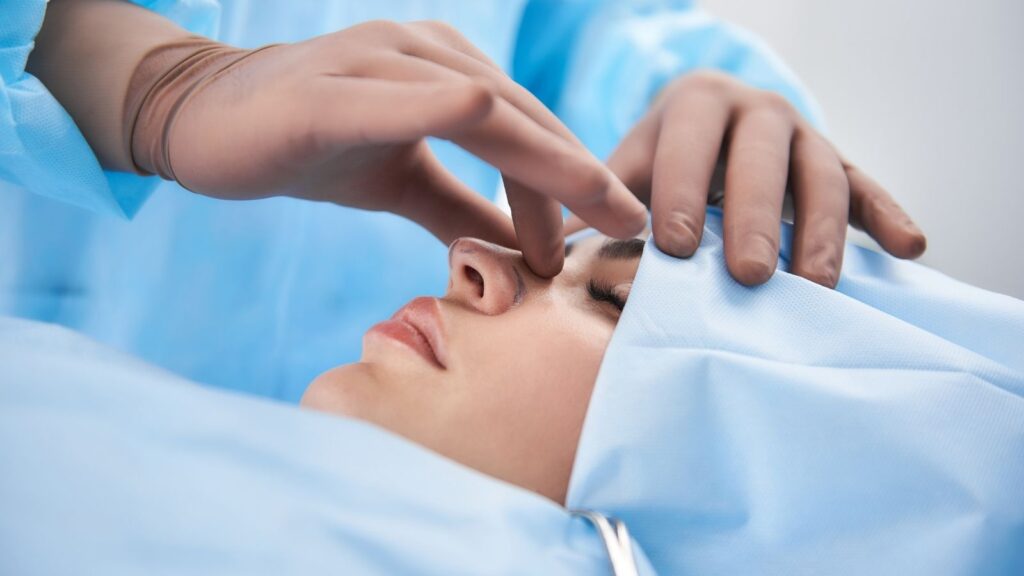
The nasal bridge is the upper part where the nasal bone and nasal cartilage meet, and it is a defining element of the facial profile. It is important both aesthetically and functionally; the curvature, straightness, or prominence of the nasal dorsum is observed in this region. Structural problems may require surgical intervention.
Depression of the nasal bridge may occur due to genetic factors, trauma, or previous surgeries. It can lead to deterioration of aesthetic appearance and breathing problems. In such cases, the area is supported with cartilage grafts to recreate the contour.
The formation of a hump on the nasal bridge is a common genetically determined deformity. A humped nose affects the profile appearance and is usually flattened with rhinoplasty. Careful reshaping of cartilage and bone tissue is required.
Nasal bridge filler is a non-surgical aesthetic procedure. Irregularities on the nasal dorsum are temporarily corrected with hyaluronic acid-based fillers. This procedure is a minimally invasive method preferred especially by individuals seeking an alternative to surgery.
| Things You Should Know | Information |
| Definition | The nasal bridge is the structure that forms the upper part of the nasal dorsum and is often also referred to as the nasal hump. It is shaped by the nasal bones and upper lateral cartilages. |
| Anatomical Structure | The nasal bridge consists of the nasal bones and upper lateral cartilages. It is located between the eyes and extends from the upper part of the nose to the nasal tip. |
| Function | It provides aesthetic balance to the facial structure and forms the main supporting framework of the nose. It also plays a role in directing airflow. |
| Aesthetic Importance | The height, width, and curvature of the nasal bridge play an important role in nasal aesthetics. A straight, hump-free, and proportionate nasal bridge is generally aesthetically preferred. |
| Common Shape Deformities | Nasal hump, depression of the nasal dorsum (saddle nose), asymmetry, and curvatures are common aesthetic problems of the nasal bridge. |
| Congenital Factors | Genetic structure is the main factor in shaping the nasal bridge. Familial similarities are common. |
| Acquired Changes | Traumas, fractures, previous nasal surgeries, and certain diseases (for example, Wegener’s granulomatosis) can affect the nasal bridge. |
| Treatment Methods | Deformities of the nasal bridge can be corrected with surgical rhinoplasty. In mild cases, filler applications may offer a temporary solution. |
| Rhinoplasty Interventions | Hump reduction, graft placement, osteotomy, and reshaping techniques may be used. |
| Points to Consider | Excessive reduction of the nasal bridge may lead to an unnatural appearance. A natural profile proportionate to the face should be targeted. |
What is the nasal bridge and what is its importance on the face?
The area we call the nasal bridge is that prominent ridge that starts between the two eyebrows and extends to the nasal tip. Although it appears as a single piece of bone, it actually has an engineering marvel of a structure. The upper part consists of rigid bones, while the lower part is made up of more flexible cartilages. The point where these two different materials meet is the most strategic region of the nose.
The importance of this area on the face is far greater than you might think. When the human brain looks at a person’s face, it performs a mapping within seconds and determines the perception of beauty according to these proportions. Since the nasal bridge is located on the exact midline of the face, it affects how we perceive whether the eyes are set far apart or close together, the prominence of the cheekbones, and even the width of the forehead. A humped structure can make the expression appear harsher and more dominant, while an overly concave curve can make the face look shorter and more childlike than it actually is.
The main components that form the nasal bridge are:
- Nasal bones
- Upper lateral cartilages
- Perichondrium
- Periosteum
- Subcutaneous connective tissue
- Nasal skin
Each of these layers requires great respect and sensitivity during surgery. Because it is not enough to simply correct the bone; the skin over it must also adapt perfectly to the new structure.
How do aesthetic appearance and breathing function meet at the nasal bridge?
The biggest concern of our patients is usually this: “Will my breathing be affected while trying to make my nose look better?” This has become a justified fear due to incorrect surgeries performed in the past. However, in modern medicine, aesthetics and function are inseparable; they can never be separated.
The nasal bridge is not just an external ornament; it is the ceiling of the internal airway. If you lower the ceiling of a room too much, there is no sense of spaciousness left inside. Similarly, if the nasal bridge is excessively narrowed or lowered due to aesthetic concerns, the narrowest and most critical area through which air passes, called the “nasal valve,” may collapse. In this case, the nose may look aesthetically pleasing from the outside, but the patient may have to sleep with their mouth open for life.
In our current approach, the priority is always to preserve the airway and, if possible, to widen it. Interventions on the nasal bridge are planned in a way that facilitates airflow. If there is a functional problem, it is definitely corrected during the aesthetic procedure.
Symptoms that indicate a breathing problem include:
- Snoring
- Morning dry mouth
- Rapid fatigue during exertion
- Persistent feeling of nasal congestion
- Decreased sense of smell
- Frequent recurrent sinusitis attacks
How is the nasal bridge evaluated in preoperative analyses?
As physicians, when we evaluate our patients, we do not only look at the nose. We focus on the whole, namely the profile. We call this “Profiloplasty.” This is because the nose is in balance with the chin and forehead. Sometimes a patient comes with the complaint “my nose is too big,” but when we analyze it, we see that the chin is actually far behind. Since the chin is retruded, the nose appears to protrude forward due to optical illusion. In such a case, reducing only the nose may lead to a weak expression on the face, which we call a “bird face.”
Therefore, in the preoperative process, we perform millimetric measurements using digital tools. We take your photographs and prepare simulations. These simulations are not intended to sell you an imaginary perfection, but to show the anatomical limits and potential of your face.
The parameters considered in preoperative analysis are:
- Forehead slope
- Nasal root depth
- Nasal tip projection
- Nasolabial angle
- Chin position
- Skin thickness
- Cartilage strength
These ratios are completely different in women and men. For example, in women, a slightly curved nasal bridge and a slightly upturned nasal tip add a feminine touch; whereas in men, a straighter and stronger nasal dorsum and a more upright nasal tip angle preserve a masculine expression. Creating the same nose for everyone means erasing a person’s character.
Why did the ‘Open Roof’ problem occur in the nasal bridge with old techniques?
In traditional rhinoplasty techniques applied for many years, the logic was quite straightforward: “If there is excess, cut it off.” Especially in humped noses, surgeons would file or remove the bone and cartilage with cutting instruments to eliminate the hump on the nasal dorsum. This process is similar to sawing off the peak of a house roof.
Think of a triangular prism. What happens when you cut off the apex? The top of the triangle becomes flattened and remains open. In medical literature, this is called “Open Roof Deformity.” When the roof of the nasal bones is cut, the nasal dorsum flattens and widens. To close this opening, surgeons had to break the bones on the lateral walls of the nose and bring them closer together. This “break and close” method could lead to irregularities during bone healing, palpable roughness, and sometimes narrowing of the airway.
The disadvantages of the traditional resection method are:
- Risk of irregularities on the nasal dorsum
- Distortion of light reflections
- Risk of narrowing in breathing function
- Prolonged swelling
- Increased need for secondary revision
How does the nasal bridge preserve its natural structure with preservation rhinoplasty?
One of the greatest revolutions in medicine in recent years is “Preservation Rhinoplasty,” a technique based on the philosophy of preservation rather than destruction. This technique works with a completely opposite logic to the traditional method mentioned above.
The philosophy is this: Why should we disrupt the natural, smooth skin and connective tissue on the nasal dorsum? Instead of cutting off the roof to correct a humped nose, why not lower the roof as a whole?
You can think of this like an elevator system. If a building has a high floor, imagine that instead of demolishing the top floor, we carefully remove soil from the foundation and lower the building by one level as it is. We do this with techniques called “Let-Down” or “Push-Down.” We do not cut the nasal hump; we remove bone and cartilage strips from the lower part of the nose, that is, from its foundation. Then we press the nasal bridge downward as a whole, without disturbing the skin, perichondrium, and natural attachments over it.
The advantages of this method are tremendous. First, the “open roof” problem does not occur because the roof has never been opened. The natural smoothness of your nasal dorsum is preserved. Second, and most importantly, since the keystone area of the nasal anatomy is not disrupted, the airway does not collapse.
Preservation rhinoplasty techniques include:
- Push Down technique
- Let Down technique
- Mix Down technique
- Septal preservation methods
Thanks to these techniques, our patients recover much faster after surgery, complaints of bruising and swelling are minimized, and most importantly, they achieve a natural nasal dorsum.
How is a depressed nasal bridge or ‘Saddle Nose’ condition corrected?
The only problem in the nasal bridge is not a humped structure. Sometimes we encounter the opposite situation, namely the collapse of the nasal dorsum. When viewed from the side, the middle part of the nose appears sunken inward, while the nasal tip seems to be left hanging. This appearance resembles the saddle used in horse riding, so it is called “Saddle Nose Deformity” in medical terminology.
This condition usually occurs as a result of trauma, contact sports such as boxing, or previously unsuccessful nasal surgeries. When the cartilage support inside the nose erodes or is removed for any reason, the roof can no longer be supported and collapses. This is not just an aesthetic problem; when the roof collapses, the airway also becomes obstructed.
Correcting a saddle nose is a much more complex “reconstruction” process than correcting a humped nose. We need to replace the missing tissue. We usually take cartilage from another part of the body, typically the rib or ear, to re-elevate and strengthen the nasal dorsum.
The causes of saddle nose include:
- Severe trauma
- Unsuccessful previous surgeries
- Certain infections
- Cocaine use
- Autoimmune diseases
What is the ‘Turkish Delight’ method in nasal bridge correction?
There is a very special and proud technique that we use in the treatment of depressions such as saddle nose or in camouflaging minor irregularities on the nasal dorsum. This technique, known in medical literature as “Turkish Delight,” was developed by world-renowned Turkish surgeons.
In the past, we would place cartilage in blocks to fill the nasal dorsum. However, block cartilage can bend over time or become visible under the skin. In the Turkish Delight method, we finely mince the cartilage (from the ear or rib) taken from the patient’s own body, almost like ground meat. We wrap these minced cartilages in a special biodegradable sheath (cellulose-based) that is compatible with the body. The result is a sausage-shaped, soft, and moldable structure filled with cartilage.
When we place this structure on the nasal dorsum, we can shape it with our hands as surgeons. Just like modeling clay, it perfectly fills all the fine depressions and elevations on the nasal dorsum. The sheath dissolves over time, but the living cartilage particles fuse together, forming a permanent, smooth, and even dorsum.
The advantages of the Turkish Delight method are:
- Excellent moldability
- Natural tactile feel
- Low risk of infection
- Low likelihood of shifting or displacement
- Not noticeable under the skin
Are filler applications safe for non-surgical nasal bridge aesthetics?
For patients who are afraid of surgery or only need very minor touches, “Non-Surgical Rhinoplasty” or “Filler Rhinoplasty” is a popular option. In this procedure, we use hyaluronic acid-containing fillers to fill depressions on the nasal bridge, camouflage the appearance of a hump, and slightly lift the nasal tip.
The biggest advantage of this procedure is that it can be performed in an office setting within 15–20 minutes and the result is visible immediately. There is no recovery period. However, I must issue a very important warning here. Although filler rhinoplasty may seem like a simple needle injection, it is actually one of the riskiest filler procedures on the face. The nasal bridge and surrounding area are adjacent to vessels that supply the eyes. If performed by inexperienced hands, it can lead to serious circulatory problems.
When we perform this procedure, we apply very strict safety protocols. While injecting the filler, we apply pressure with our fingers on the sides to protect blood flow in the vessels. This procedure should only be performed by specialist physicians with complete mastery of anatomy.
Conditions that can be corrected with fillers include:
- Mild humped structures
- Small depressions on the nasal dorsum
- Mild asymmetries
- Adjustment of nasal root depth
- Minor irregularities remaining after surgery
Are thread lift methods effective on the nasal bridge?
Another method you may have heard frequently recently is thread lift applications. In this procedure, the nasal tip is lifted upward with special threads placed under the skin. It is a short procedure performed under local anesthesia.
To be frank, the thread lift method does not change the bony structure of the nasal bridge. If you have a humped nose, a thread lift will not eliminate that hump. However, when the nasal tip is lifted, the nasal dorsum may appear straighter as an optical illusion. This method can be a temporary alternative for patients who do not want their bone structure to be altered, who only complain about drooping of the nasal tip, and who are seeking a minimal change.
The limitations of the thread lift method are:
- Short duration of permanence
- Inability to change the bone structure
- Threads may loosen over time
- Not suitable for every nasal structure
How does nasal bridge healing proceed in the postoperative period?
The healing process varies depending on the type of intervention performed on the nasal bridge. In traditional breaking procedures, bone healing and reduction of swelling may take some time, whereas this period is much shorter with preservation rhinoplasty techniques.
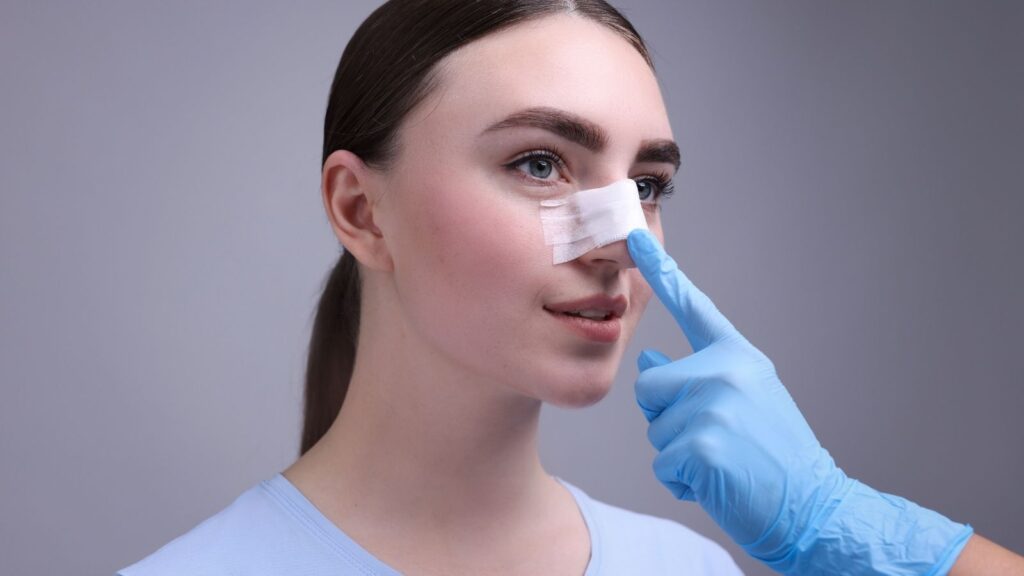
During the first week, there will be a splint (plaster or thermoplastic mold) on your nose. This splint ensures that the shape we have given is maintained. When the splint is removed, you may find your nose somewhat swollen, which is completely normal. The complete resolution of swelling on the nasal bridge and the settling of the skin can take between 6 months and 1 year, depending on the individual’s skin type. In patients with thick skin, this period may be slightly longer.
Points to pay attention to during this process include:
- Avoiding the use of glasses
- Protecting against impacts
- Protecting from sunlight
- Performing the massages recommended by the doctor
- Limiting salt intake
What is the most accurate roadmap for a healthy and aesthetic nasal bridge?
As seen, nasal bridge management is not a standardized procedure with a single formula. Every face is unique, like a fingerprint. Your bone thickness, cartilage flexibility, skin structure, facial proportions, and breathing capacity… All must be evaluated.
As a physician, my fundamental philosophy is the principle of “first, do no harm, then do the best.” Preservation rhinoplasty techniques, which shape by preserving what exists rather than demolishing and rebuilding the nasal roof, are the gold standard of today. If there is a significant collapse in your nose, reconstruction methods using your own tissues are the safest harbor.
Remember, the best nose aesthetics is a nose that does not look like you have had surgery, does not appear as if it was “added later” to your face, and allows you to freely fill your lungs with oxygen. When starting this process, instead of saying “just make my nose smaller,” setting out by saying “let’s plan the most suitable, functional, and natural nose for my face” will lead you to the happiest outcome.
Frequently Asked Questions
What are the common causes of nasal bridge collapse?
Nasal bridge collapse may develop as a result of trauma, previous nasal surgeries, septum deviation surgery, or autoimmune diseases that lead to cartilage loss. This condition can cause both aesthetic and functional problems.
Does nasal bridge curvature cause breathing problems?
Yes, if the curvature of the nasal bridge is associated with narrowing of internal nasal structures or septum deviation, it can restrict airflow and make nasal breathing difficult. This is a commonly encountered respiratory problem.
How can aesthetic concerns be addressed in individuals with a prominent nasal bridge?
A prominent nasal bridge can be reduced or softened with rhinoplasty. In milder cases, dermal filler applications can temporarily balance the nasal profile and achieve a softer appearance.
How long do nasal bridge fillers last?
Hyaluronic acid fillers applied to the nasal bridge generally provide permanence for 12 to 18 months. This duration may vary depending on the filler used and the individual’s metabolic rate.
Which aesthetic procedures are recommended for individuals with a low nasal bridge?
In cases of a low nasal bridge, the nasal dorsum can be elevated with fillers or a permanent solution can be achieved surgically by adding cartilage grafts. This approach is commonly applied, especially in individuals of Asian descent.
What is the recovery process like after nasal bridge surgery?
Swelling and bruising may be observed in the first weeks after surgery. Significant improvement is usually achieved within 1–2 weeks, but it may take 6–12 months for the nasal bridge to take its final shape.
Does a bony protrusion on the nasal bridge cause pain?
A bony protrusion is mostly considered an aesthetic issue. However, if it develops after trauma or is related to the sinuses, it may cause sensitivity and occasional pain.
How are facial proportions affected in individuals with a wide nasal bridge?
A wide nasal bridge can create a strong emphasis at the center of the face, making other facial features appear smaller. This can negatively affect facial symmetry and aesthetic proportions.
Do nasal bridge problems affect visual function?
Nasal bridge problems do not directly affect visual function. However, if severe deformities or trauma affect the bones around the eyes, indirect problems may occur.
From what age can nasal bridge correction be performed?
Aesthetic or functional procedures for the nasal bridge are generally performed after the completion of nasal development, around the ages of 17–18. Surgical intervention at earlier ages is evaluated only in special cases.