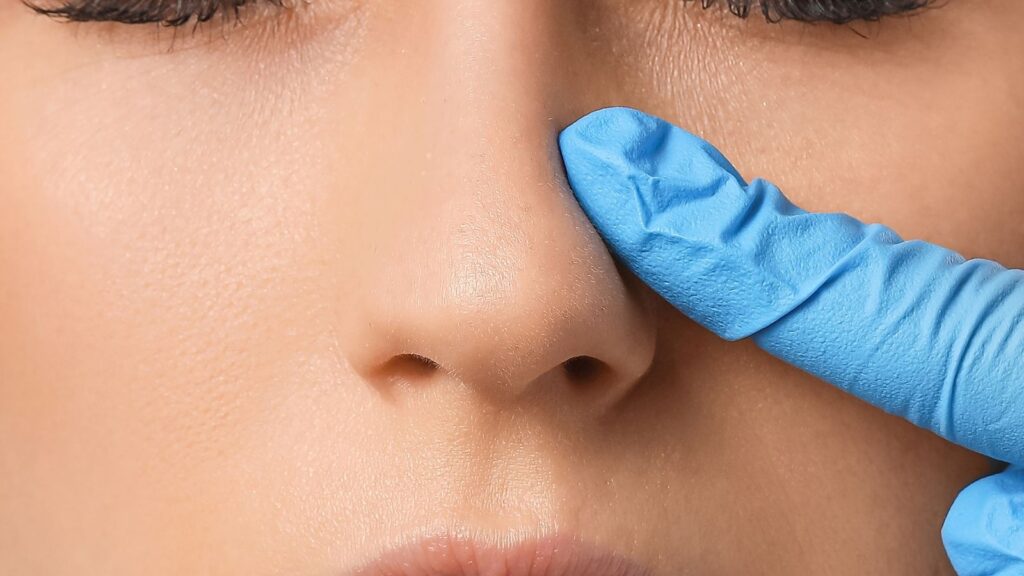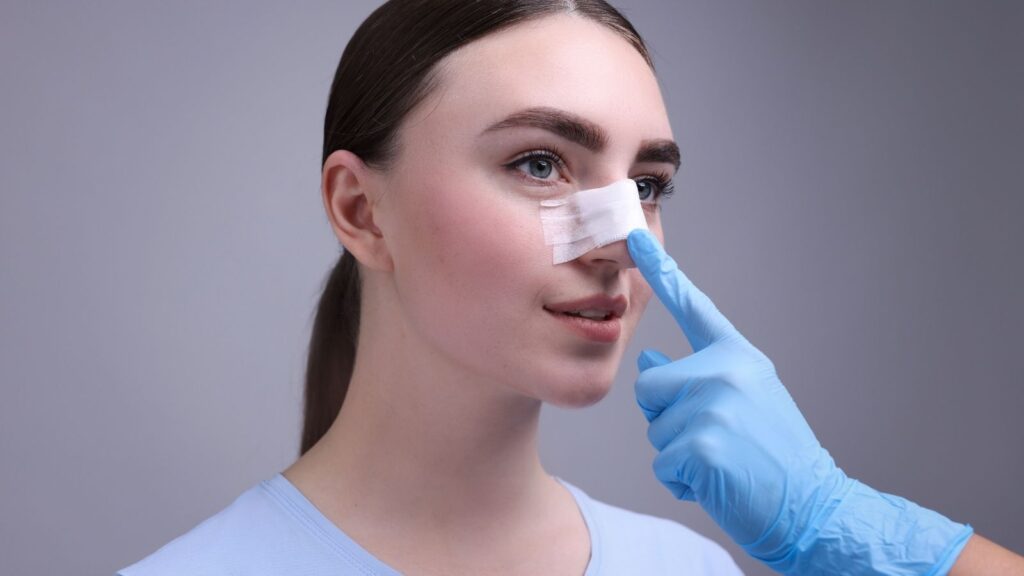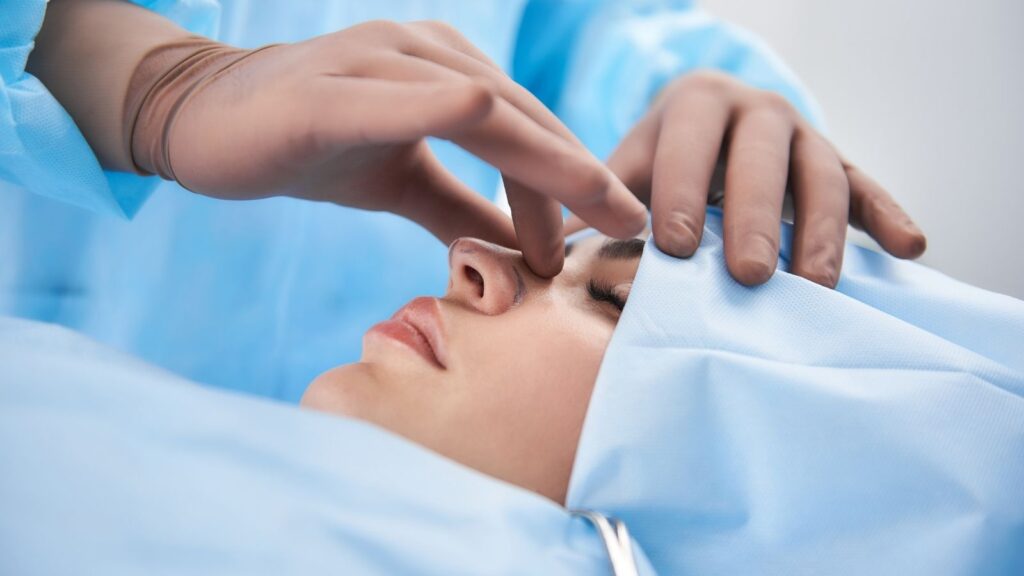
A Roman nose is a prominent nose type that draws attention with its characteristic arched structure. It develops due to genetic factors, and a protruding structure is typically seen on the nasal bridge. For individuals who apply with aesthetic concerns, rhinoplasty is the most frequently preferred solution method.
The anatomical features of the Roman nose type are defined by distinct protrusions in the bone and cartilage structure. This protrusion creates a curvature on the nasal dorsum, giving the profile a sharp appearance. Although this condition does not directly affect breathing functions, it may be aesthetically disturbing.
Roman nose aesthetics is generally performed by filing down the arched structure on the nasal dorsum and reshaping the nasal tip. Surgical planning is carried out by taking the patient’s facial proportions into account, and a natural appearance is targeted. The postoperative recovery process varies from person to person.
Psychosocial effects may be observed in individuals with a Roman nose type. Especially a nasal structure that is disproportionate to the facial features may lead to self-confidence issues. Aesthetic interventions can positively change this perception and improve the individual’s quality of life.
| Things You Should Know | Information |
| Definition | A Roman nose is a characteristic nose type in which the nasal bridge is straight or slightly prominent, while the nasal tip is distinctly slanted downward. It is often described as a “curved” or “arched” nose. |
| Anatomical Features | There is a slight hump on the upper part of the nose (nasal dorsum). The nasal tip is generally in a low position, and the nose appears long. |
| Genetic and Racial Factors | A Roman nose is more common particularly in individuals of Mediterranean, Middle Eastern, and Southern European origin. It is a genetically inherited facial feature. |
| Aesthetic Evaluation | While it provides a characteristic and noble appearance for many people, some individuals may want the nose shape to be corrected due to aesthetic concerns. |
| Common Aesthetic Interventions | People with this nose type often request rhinoplasty (nose aesthetics). Especially removal of the nasal hump and lifting the nasal tip are targeted. |
| Functional Status | This nasal structure generally does not affect breathing function, but in some people septal deviation or turbinate hypertrophy may accompany it. |
| Rhinoplasty Process | In aesthetic surgeries performed for a Roman nose, filing down the arched part (hump reduction) and reshaping the nasal tip stand out. The surgery can be performed with an open or closed technique. |
| Recovery Process | Although recovery after rhinoplasty varies from person to person, most swelling subsides within 1–2 months. Full recovery may take 6–12 months. |
| Psychological Effects | If the nasal structure is disproportionate to the person’s face, self-confidence problems may develop. Psychological improvement may also be observed after aesthetic interventions. |
| Alternative Interventions | With non-surgical filler applications, the nasal line can be temporarily straightened; however, for a permanent solution, surgery is generally preferred. |
What Is a Roman Nose (Arched Nose) and Why Does It Occur?
If, when you look at yourself from the side in the mirror, you see a distinct bump or protrusion on the bridge of your nose, you have the structure referred to in the literature as “prominent nasal dorsum,” and commonly known as a “Roman nose” or “arched nose.” This is not actually a disease or a health defect. Although historically it has been seen as a symbol of strength, character, and authority, today’s aesthetic perception tends to favor noses that are softer, more balanced, and more harmonious with facial features.
The most fundamental factor in the formation of a Roman nose is the overdevelopment of the bony and cartilaginous structures that make up the roof of the nose. Instead of descending in a straight line, the nasal dorsum forms an elevation at the junction point of bone and cartilage. This is not only related to bone; the cartilage structure generally accompanies this height as well.
The main factors that play a role in the formation of this structure are:
- Genetic inheritance
- Ethnic origin
- Childhood trauma
- Developmental differences
- Hormonal factors
How Does a Roman Nose Affect Facial Expression and Psychology?
The nose, located at the very center of the face, is the most influential feature in determining expression after the eyes. A large, arched nose structure can give a person a harsher, older, or more tired expression than they actually have. Especially in women, a very prominent nasal hump can mask feminine softness in the face and lead to a more masculine appearance.
The psychological reflection of this on individuals is quite profound. The need to constantly look for a certain angle when taking photos, not being able to laugh comfortably because the nose appears even more arched when smiling, or anxiety about being seen from the side profile in social environments are common situations. This aesthetic concern can, over time, undermine the person’s self-confidence and restrict social relationships. Our aim is not to completely change the person’s facial character, but to soften these sharp transitions so that the person can be at peace with their own face.
Is an Arched Roman Nose Only an Aesthetic Problem?
Although arched noses may appear from the outside as only a shape issue, they often bring along some problems in the internal structure as well. The nose develops as a whole; the higher and more curved the bony and cartilaginous roof on the outside, the higher the likelihood that the cartilaginous wall inside—called the septum—which divides the air tunnels into two, will also be deviated.
Functional complaints frequently encountered in people with an arched nose structure include:
- Nasal congestion
- Sleeping with the mouth open
- Snoring
- Morning fatigue
- Difficulty smelling
- Frequent sinusitis attacks
- Throat dryness
For this reason, when planning correction of a Roman nose, focusing only on the external appearance would be a major mistake. While aesthetic improvement is performed, the airways must also be opened and breathing function must be maximized.
How Should Preoperative Roman Nose Analysis Be Performed?
A successful result begins not in the operating room, but with a detailed analysis performed in the examination room. Not every arched nose is the same, and every face has its own unique geometry. The point where the hump begins, the peak point where it is highest, and its relationship with the nasal tip must be evaluated in millimetric detail.
In this analysis, not only the nose but also other parts of the face are included in the equation. For example, in someone whose forehead is very flat and retruded, the nasal hump appears much larger than it is. Or in a patient with a retruded chin, the nose may look as if it is projecting far forward. In such cases, reducing only the nose may not be enough; it may be necessary to achieve profile balance with additions such as fat injection to the forehead or filler/implant to the chin tip.
Critical anatomical points considered during analysis are:
- Forehead–nose angle
- Nose–lip angle
- Chin tip position
- Cheekbone prominence
- Skin thickness
- Nasal tip support
Is Nose Filing Enough for a Roman Nose?
The procedure commonly known as “filing,” medically called “rasping,” is the reduction of the bony protrusion on the nasal dorsum by shaving it down with special instruments. This method can be an appropriate and practical solution for patients whose hump is very mild and whose nasal roof is not very high.
However, in a true Roman nose, meaning the presence of a prominent and high hump, filing alone is generally not sufficient. If a very large hump is only filed down from above, the nasal dorsum becomes flatter but also wider. In this situation, called “open roof deformity,” the nasal dorsum looks flat and wide like a platform. To prevent this appearance, after removing the hump, it is necessary to cut the bones on the side walls as well (osteotomy), bring them closer together, and close the roof again in a “roof” form. Therefore, filing is not a standalone method but only one part of the surgical process.
How Is Naturalness Preserved in a Roman Nose with Preservation Rhinoplasty?
One of the biggest changes in nasal aesthetics in recent years has been the widespread adoption of the philosophy of “Preservation Rhinoplasty.” In traditional methods, the nasal hump was cut off and the nasal roof was attempted to be rebuilt. This could sometimes lead to irregularities on the nasal dorsum, palpable roughness, or disruption of light reflections.
In preservation rhinoplasty, the logic works in the opposite way. The natural, smooth connective tissue and cartilage structure on the nasal dorsum are not disrupted. Instead of cutting the hump from above, bone and cartilage are removed from the base (foundation) of the nose, and the entire nose is pressed downward as a whole (push-down or let-down). In other words, we are not removing the roof to reduce the building’s height; we are lowering the foundation and bringing the building down as it is.
The advantages provided by this technique are:
- Natural dorsal line
- Smooth surface
- Less swelling
- Fast recovery
- Preservation of nerves
- Tissue integrity
What Advantages Does Piezo Surgery Offer in Correcting a Roman Nose?
With the integration of technology into surgery, Piezo devices that use ultrasonic sound waves have come to the forefront in bone shaping instead of rough instruments. Piezo surgery provides the surgeon with great precision and a safety margin, especially in cases like a Roman nose where bone intervention is intensive.
The greatest feature of this technology is that it is “selective.” Piezo tips cut or shape only hard tissue (bone); when they touch soft tissue (skin, vessels, nerves, mucosa), they stop and do not cause damage. In this way, the amount of bleeding during surgery decreases significantly. Less bleeding also helps keep bruising and swelling—patients’ biggest fears after surgery—at a minimum level.
In addition, in arched noses, it is possible with Piezo to perform millimetric thinning like sculpting, without breaking the bone. This precision also minimizes the risk of irregularities that may occur during bone healing in the recovery period.
The comfort advantages offered by Piezo surgery are:
- Minimal bruising
- Less swelling
- Precise cutting
- Fast recovery
- Tissue safety
Is Nasal Tip Drooping Common in People with a Roman Nose?
Yes, nasal tip drooping is also present in a large majority of people with an arched nose structure. In fact, sometimes the hump is not that large, but the nasal tip is so low that the dorsum appears relatively much more arched. This can also be called the appearance of a “pseudo-hump.”
The nasal tip is formed by cartilages and the ligaments that hold them. In a Roman nose structure, these ligaments are generally weak, or the muscles that pull the nasal tip downward are overly active. Especially when the person smiles, the nasal tip droops downward and the hump becomes much more prominent.
For this reason, in surgical planning, it is not enough to only remove the hump. The nasal tip must also be brought to the ideal angle, and most importantly, it must be strengthened so that it remains permanently in its new position. With cartilage supports such as “strut graft” or “septal extension graft,” the nasal tip is given a solid structure. Thus, even as years pass, the nasal tip does not succumb to gravity.
Is Roman Nose Surgery More Difficult in Thick-Skinned Patients?
One of the most important factors determining the outcome of rhinoplasty is the quality of the skin. Patients who have a Roman nose and also thick, oily skin require a more meticulous surgical approach. Thick skin tends to mask the fine work done underneath.
In a thick-skinned patient, reducing the hump too much can sometimes lead to undesirable results. Because the skin has less elasticity, it cannot adhere to the reduced framework, and a gap remains in between. This gap may fill over time with healing tissue, causing the nose to look bulky. This is called the “dead space” problem.
Therefore, in thick-skinned patients, instead of making the nose excessively small, it is necessary to leave a framework strong enough to keep the skin taut. In addition, the swelling period after surgery is longer in these patients and requires patience.
Process details that thick-skinned patients should know are:
- Long swelling period
- Masking effect
- Limited reduction
- Patient follow-up
- Need for massage
Is Roman Nose Aesthetics Different in Men Than in Women?
Male and female facial anatomy and aesthetic goals are completely different from each other. While a slightly curved, slightly upturned, and delicate nose can look very nice on a woman, the same nose, when done on a man, softens the facial expression and leads to a feminine appearance.
When correcting a Roman nose in men, the main goal is to eliminate the hump but preserve the masculine character of the nose. The nasal dorsum should be straight, not curved. The angle between the nose and the lip should be kept around 90–95 degrees, and the nasal tip should not be lifted excessively. In fact, in some cases, even leaving a very slight hump may be preferred to preserve that strong stance in the man’s facial expression.
The aesthetic criteria targeted in male rhinoplasty are:
- Straight nasal dorsum
- Strong nasal tip
- Ideal angle
- Masculine lines
- Natural appearance
What Awaits You During the Roman Nose Surgery Process and Recovery Period?
Although deciding on surgery may seem like the hardest part of the process, thanks to modern techniques, the surgery and recovery period are now much more comfortable for patients. The procedure performed under general anesthesia takes an average of 2–3 hours.
Our patients usually mention a feeling of pressure rather than pain when they come out of surgery. Contrary to popular belief, rhinoplasty is not a painful surgery, and this process can be managed very comfortably with simple painkillers. One of the most wondered topics is nasal packing. We now use silicone splints with an airway channel in the middle instead of gauze packings. In this way, you can breathe through your nose even immediately after surgery, and you do not feel pain when the splints are removed.
In the first 48 hours, facial swelling and, if bone intervention was performed, mild discoloration around the eyes are normal. These regress rapidly within 1 week. At the end of day 7, the plastic cast on the nose and the silicone inside are removed. From this point, “return to social life” begins. However, for the nose to take its final shape, for the skin to thin, and for details to emerge is a process that varies between 6 months and 1 year.
Restrictions to pay attention to during the recovery period include:
- Use of glasses
- Heavy sports
- Excessive heat
- Risk of impact
- Sunlight
Are There Risks and Complications in Roman Nose Surgery?
As with every surgical procedure, there are some risks in rhinoplasty as well. Even if perfection is targeted, the healing response of human tissue is not always 100% predictable. In surgeries like a Roman nose where large volume changes are made, some issues may arise during the adaptation of tissues to the new position.
One of the most common situations is mild asymmetries or millimetric irregularities that can be felt by hand after swelling subsides. In addition, although rarely, general surgical risks such as infection or bleeding may be seen. Functionally, breathing problems may occur due to intranasal adhesions or cartilage curvatures not being fully corrected. However, in experienced hands and with modern techniques, the rate of these risks is quite low.
Possible complication headings include:
- Bleeding
- Infection
- Asymmetry
- Breathing problems
- Change in smell
- Skin problems
Is a Second Surgery (Revision) Necessary for a Roman Nose?
When looking at worldwide statistics, even in the best clinics there is a revision (corrective surgery) need at a rate of 5% to 10%. This does not mean the first surgery failed; it stems from the fact that tissue healing is a dynamic process.
Especially in arched noses, it is said that bone and cartilage have a “memory.” Cartilages may sometimes tend to return to their previous curved form. Or during bone healing, bone tissue—called “callus”—may form and create a slight bump. In such cases, the problem can usually be resolved with a small touch-up procedure performed 1 year after the first surgery.
Factors that increase the likelihood of revision are:
- Traumatic history
- Severe curvature
- Thick skin
- Thin skin
- Smoking
- Impaired healing
What Should Be Considered for a Natural Roman Nose Result?
In conclusion, Roman nose aesthetics is a procedure with strong artistic and medical aspects, aiming to rebuild the harmony of the face. For a successful result, the most critical step is choosing the right surgeon and healthy communication.
We always remind our patients of this: “The best nose is the one that does not look like it was operated on.” Instead of asking “Who did your nose?” it is much more valuable for people to say, “There’s a beauty, a freshness in your face.”
It is necessary to keep expectations realistic, to speak openly with your doctor, and not to forget that the healing process is a marathon. No matter how advanced technology gets, tissues need time to heal. By not rushing, giving your body time, and paying attention to your doctor’s warnings, you can achieve the natural, breathing, and face-suiting nose of your dreams.
The golden rules for a natural result are:
- Realistic expectations
- Correct analysis
- Personalized plan
- Functional preservation
- Patient process
Frequently Asked Questions
How does a Roman nose align with face shape?
A Roman nose is generally characterized by a prominent and protruding structure. Depending on the face shape, it can provide a strong and striking appearance; it creates an aesthetic balance especially in oval and long faces.
Is a Roman nose aesthetically advantageous?
Many people consider a Roman nose charismatic and characteristic. Whether it is aesthetically advantageous depends on personal preference and how the nose aligns with facial features.
In whom is a Roman nose more common genetically?
A Roman nose is genetically more common, especially in Mediterranean communities and the southern regions of Europe. This nose type can be passed down through generations within a family.
Does a Roman nose structure cause breathing problems?
On its own, a Roman nose structure does not cause breathing problems. However, if there is accompanying septal deviation or internal structural problems, respiratory difficulties may develop and treatment may be needed.
Can a Roman nose be corrected with surgery?
Yes, a Roman nose can be reshaped with rhinoplasty. Depending on the patient’s wishes, the hump can be reduced or the nasal profile can be made softer and more balanced.
Which aesthetic technique is most suitable for those with a Roman nose?
Open rhinoplasty is often preferred for Roman noses. This technique provides the surgeon with more control in hump reduction and nasal tip reshaping procedures.
What is the recovery process like after Roman nose surgery?
Although the recovery process varies by person, the cast is usually removed within 1 week. Bruising decreases within 10–14 days, and the final shape of the nose settles fully in 6–12 months.
How does the face change after Roman nose aesthetics?
By softening the nasal hump, the face can gain a more balanced, softer, and younger appearance. However, excessive changes can significantly alter the facial character.
Can someone with a Roman nose achieve a natural look after rhinoplasty?
With the right surgical technique and planning suitable to facial proportions, a highly natural appearance can be achieved after Roman nose aesthetics. The main criterion is preserving the nose–face proportion.
How can a Roman nose affect personality perception?
In society, a Roman nose is associated with strong, charismatic, and leader-spirited individuals. This perception can be influential in social impressions based on appearance.