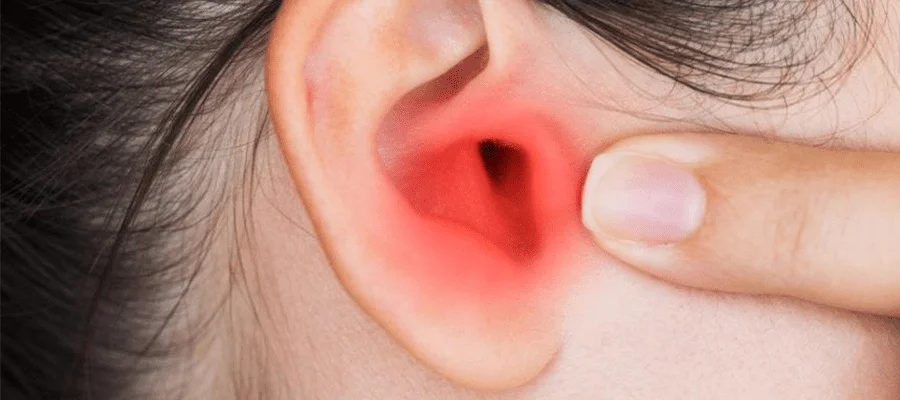
Acute middle ear infections are generally caused by bacteria or viruses. In children, these agents are easily transported from the throat to the middle ear through the short Eustachian tube. Once they reach the middle ear, the microorganisms settle and multiply, causing swelling of the mucosa lining both the middle ear and the Eustachian tube. Due to blockage of the tube, the middle ear cannot be ventilated. As the existing air is absorbed, pressure decreases and the eardrum is pulled inward. The eardrum loses its elasticity, reducing sound transmission. On the other hand, inflammatory fluid caused by microorganisms already present or drawn from the nasopharynx due to negative pressure accumulates in the middle ear, pushing the eardrum outward.
During examination in the early stage, the eardrum appears red, swollen, or bulging like a balloon (Figure 2). The middle ear is filled with inflammation. As the membrane thins and ruptures at one point due to inflammation, the fluid in the middle ear drains out, causing ear discharge. At this stage, complaints of fever and pain decrease relatively. Failure to provide appropriate treatment may result in disease progression and the development of complications.
Figure 2. The normal appearance of the eardrum is shown on the left, while the appearance of the eardrum in acute middle ear infection is shown on the right. You can contact us to get information about acute middle ear infection treatment.
- Impaired Eustachian tube function
- Growth of bacteria in the middle ear
- Diseases of the nose and sinuses
What Is a Middle Ear Infection?
A middle ear infection is inflammation caused by the accumulation of fluid in the middle ear, usually due to bacterial or viral infections. It is especially common in children. It may present with ear pain, hearing loss, and sometimes fever. Treatment generally includes pain relievers and, when necessary, antibiotics. Early intervention is important; otherwise, permanent hearing problems may develop.
CAUSES OF ACUTE MIDDLE EAR INFECTION
- Other upper respiratory tract diseases
- Allergy
- Immune system deficiency
- Spread of infection to the ear through the bloodstream (rare)
DIAGNOSIS OF THE DISEASE
It is an inflammatory condition that begins and progresses rapidly in the middle ear.
If symptoms such as ear pain, fever, vomiting, loss of appetite, ear blockage, ear discharge, hearing loss, or ear pulling in infants are observed, it is recommended to consult an ear, nose, and throat specialist immediately.
In such a case, it is important to diagnose the infection and begin treatment as early as possible.
If it is thought that your child has an ear problem, both eardrums should be examined and the necessary tests performed. The treatment approach is planned according to the examination findings, test results, and your child’s overall health condition.
EXAMINATION FINDINGS
In children with enlarged tonsils, the adenoid tissue located around the opening of the Eustachian tube into the throat is usually also enlarged, negatively affecting the function of the Eustachian tube. In some cases, airborne microorganisms may become trapped there and be transmitted to the middle ear through the Eustachian tube. The adenoids play a very important role in ear infections. When a middle ear problem is suspected, the eardrums, nose, throat, and adenoids should be examined. Examination of the adenoids is particularly important in children with frequent infections, chronic nasal obstruction, sleeping with the mouth open, or snoring.
TREATMENT
Most children experience at least one middle ear infection within their first two years of life. The frequency of infections and the duration of active infections play a role in determining treatment. In the treatment of acute otitis, antibiotics should be used for at least 10 days. With today’s medications, very serious complications such as facial paralysis, hearing loss, intracranial infections, meningitis, and brain abscesses, which were more common before the antibiotic era due to the spread of infection from the middle ear to neighboring organs, are now rarely seen.
Treatment includes an appropriate antibiotic along with fever reducers, pain relievers, and medications to reduce mucosal swelling. The healing process should be monitored. In many children, medication and elimination of risk factors are sufficient for treatment. Symptoms should decrease significantly within the first 24–48 hours of antibiotic treatment. Complete drainage of middle ear fluid and full recovery of hearing usually occur within 8–12 days, although this may sometimes take up to six weeks. If the accumulated fluid becomes chronic, long-term follow-up or even surgical intervention may be necessary. The main factors that increase the risk of chronic middle ear fluid (serous otitis, secretory otitis) in children include:
- Crowded, poorly ventilated environments such as daycare centers or nurseries
- Allergic predisposition
- Exposure to cigarette smoke
- Enlargement of the adenoids
- Frequent upper respiratory tract infections
SURGICAL TREATMENT
In some cases, medication alone may not be sufficient to control middle ear problems. If fluid in the middle ear does not disappear despite repeated treatments and causes hearing loss and/or collapse of the eardrum, surgical methods are necessary. The most commonly performed surgical procedure for recurrent acute middle ear infections and persistent middle ear fluid is insertion of ventilation tubes into the eardrum. The tubes may remain in your child’s ear for approximately 6–12 months. The duration depends on your child’s growth. Following a growth spurt, the tubes may fall out spontaneously. Otherwise, they should remain in place for at least six months and, if they have not fallen out, should preferably be removed before the summer season. The opening left after tube removal usually closes spontaneously within 2–3 weeks. If ear problems recur after the tubes fall out, tube insertion may need to be repeated.
During tube placement, the adenoids should also be evaluated, and children with a history of recurrent tonsillitis or excessively enlarged tonsils on examination may also require tonsil removal.
MIDDLE EAR
The middle ear is a cavity located behind the eardrum (Figure 1). The pressure inside tends to become negative as air is absorbed by the middle ear mucosa. During swallowing, the middle ear pressure is equalized with atmospheric pressure through the Eustachian tube. When the pressure on both sides of the eardrum is equal, it becomes fully flexible, allowing optimal sound transmission. However, if middle ear pressure decreases, sound transmission problems begin to occur. This condition is usually caused by dysfunction of the Eustachian tube connecting the middle ear to the nasopharynx. This tube both regulates middle ear pressure and provides drainage of middle ear secretions. In young children, the Eustachian tube is both short and straight, but after the age of seven it develops an anatomy capable of fully performing its functions.
NORMAL HEARING
For normal hearing, the middle ear structures and the eardrum must transmit sounds reaching the eardrum through the external auditory canal to the inner ear. When a sound wave from outside travels through the external ear canal and strikes the elastic eardrum, it causes the membrane to vibrate. The tiny bones of the middle ear participate in this vibration. These vibrations then reach the inner ear, where they are converted into electrical signals by nerve cells and transmitted through the auditory pathways to the hearing centers of the brain.
Serous Otitis Media (Serous Otitis Media, Otitis Media with Effusion)
The most important cause is dysfunction of the Eustachian tube, which normally opens briefly during each swallow to regulate middle ear pressure, due to viral infections, allergic reactions, and similar conditions. As a result, the middle ear cannot be ventilated, and fluid accumulates because of both ear secretions and negative pressure created by air absorption, drawing fluid from surrounding tissues into the middle ear (serous otitis). If the negative pressure persists, thickening of mucosal secretions leads to a more chronic condition known as secretory otitis media. Because of this fluid, the eardrum cannot vibrate properly, resulting in hearing loss in the child. This mild hearing loss may cause various behavioral changes. If the problem becomes chronic, it may delay the child’s mental development and speech development. The main findings observed in children with hearing loss include:
The child turns the television volume up very high or sits very close to the television.
The child does not respond immediately, or ignores what is said because they cannot hear clearly.
The child’s interest in what the teacher says at school decreases, and academic performance begins to decline. Middle ear fluid and hearing loss should always be investigated in children who perform poorly at school.
Speech disorders may develop, especially due to difficulty hearing consonants such as “s” and “z”.
CAUSES OF SEROUS OTITIS
- Enlargement of the adenoids filling the nasopharynx (adenoid vegetation)
- Nasal and sinus infections
- Acute middle ear infections
- Allergy, immune system deficiency
- More rarely, tumors affecting Eustachian tube function
DIAGNOSIS OF SEROUS OTITIS
Serous otitis is a silent disease and generally does not present with obvious complaints such as fever, vomiting, or pain. It is often diagnosed during examinations performed because of adenoid-related complaints or when hearing loss is suspected.
The eardrum appears dull, thickened, and has increased vascularity. Depending on the duration of the problem, retraction of the membrane, adhesions toward the middle ear structures, and dark discoloration may occur. The disease often affects both ears simultaneously. In unilateral serous otitis, hearing loss may go unnoticed. In these patients, findings such as imbalance, difficulty with sports activities, and difficulty walking may occur due to involvement of the balance center. Diagnostic tests include middle ear pressure measurement, acoustic reflex testing, and hearing tests in cooperative children. Hearing loss is of the conductive type. Rarely, sensorineural hearing loss may develop due to substances secreted by microorganisms in the middle ear.
TREATMENT
Initially, antibiotic therapy is administered. Medications that reduce mucosal swelling and thin mucus may also be used. Anti-allergic treatment should be added in patients diagnosed with allergies. Activities such as chewing gum and blowing up balloons may help improve Eustachian tube function.
Children with serous otitis accompanied by recurrent acute otitis attacks, especially those attending daycare, may benefit from staying away from such environments for about one month. In bottle-fed infants, feeding in a semi-upright position is recommended.
Since the disease becomes more common during autumn and winter due to increased viral infections, treatment planning may vary according to the season. The success rate of medical treatment is higher before summer, whereas it decreases during winter.
If treatments administered over six to eight weeks are unsuccessful and hearing loss exceeds 20–25 dB, surgical treatment is preferred. Surgery may also be chosen directly if thinning, collapse, or pocket formation of the eardrum is present, sensorineural hearing loss has developed, or balance disorders have begun.
In surgical treatment, a ventilation tube is inserted into the eardrum, after which hearing loss improves immediately. In addition, the adenoids and, if necessary, the tonsils may be removed. Ventilation tubes are inserted under general anesthesia in children, usually remain in the eardrum for 6–12 months, and then fall out spontaneously or are removed by the physician. With these treatments, the majority of patients recover completely. Rarely, repeated tube insertions or permanent tube placement may be necessary. Especially in children with recurrent serous otitis, allergies and immune system functions should be evaluated.
Children with ventilation tubes in their eardrums can generally swim in the sea provided the water is clean and they do not dive deeper than one meter. However, especially when swimming in pools or taking showers or baths with soapy water, the external ear canal should be sealed with petroleum jelly-coated cotton or a suitable earplug to prevent water from entering the middle ear through the tube.